Executive Summary
A domestic violence matter in New Jersey is rarely one case — it is usually two cases running at the same time: a civil restraining order proceeding in the Family Division of the Superior Court, and a separate criminal charge for the underlying offense. They have different courtrooms, different standards of proof, and very different consequences, and a person can lose one while winning the other.
This guide explains the framework created by New Jersey’s Prevention of Domestic Violence Act (PDVA), who the law protects, what conduct qualifies, how a temporary restraining order becomes a permanent one, what penalties attach to the criminal side, and the realistic defense options available to someone accused in Hackensack, Bergen County, and the surrounding region. It is written for the person who was served with papers yesterday and needs to understand, quickly and accurately, what is actually happening to them.
Table of Contents
- Domestic Violence in New Jersey: The Two-Track System
- The Prevention of Domestic Violence Act, Explained
- Who Is Protected? The Relationship Requirement
- What Counts as Domestic Violence: The Predicate Offenses
- Restraining Orders: From TRO to FRO
- The Criminal Track: Charges and Penalties
- Weapons, Firearms, and Immediate Consequences
- How a Bergen County Case Typically Unfolds
- Defense Options: What Actually Works
- Myth vs. Fact
- Frequently Asked Questions
- Key Takeaways
- Glossary of Legal Terms
- Conclusion
Understanding New Jersey Domestic Violence Law
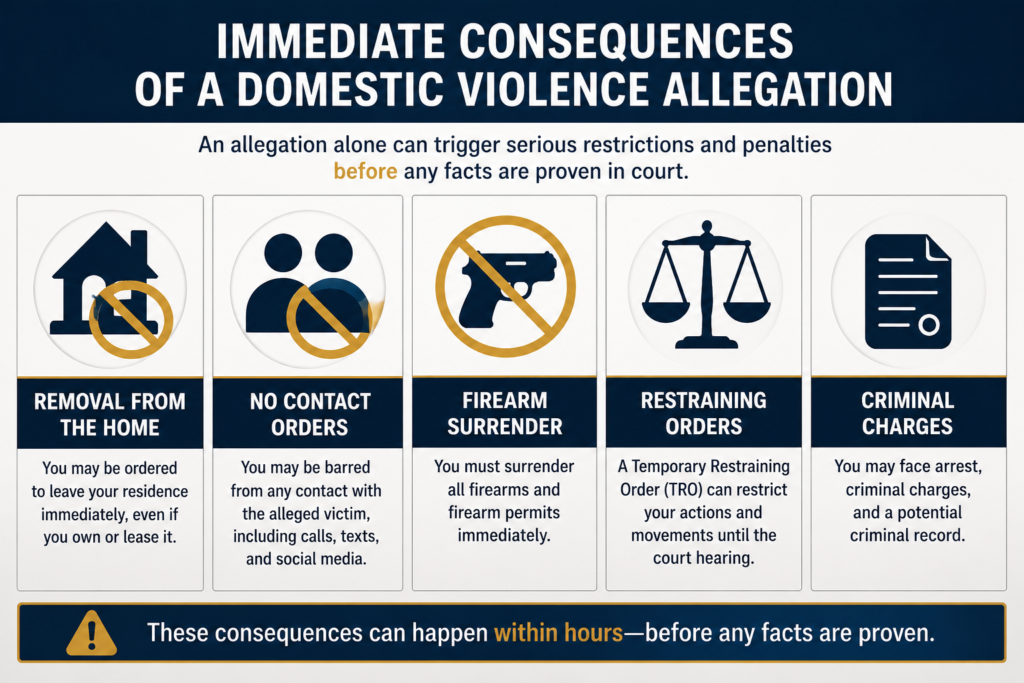
Few areas of New Jersey law move as fast, or reach as far into a person’s daily life, as domestic violence. Within hours of an allegation, someone can be removed from their own home, barred from contacting their children, ordered to surrender every firearm they own, and left facing a criminal record — all before a single fact has been proven at trial. Understanding how the system is built is the first step to responding to it intelligently.
Direct answer: In New Jersey, “domestic violence” is not itself a single crime. It is a legal category defined by the Prevention of Domestic Violence Act (N.J.S.A. 2C:25-17 and following). When a person in a protected relationship commits one of a specific list of criminal offenses against another, the conduct is treated as domestic violence, which unlocks two parallel legal tracks: a civil restraining order in Family Court and a criminal prosecution for the underlying offense.
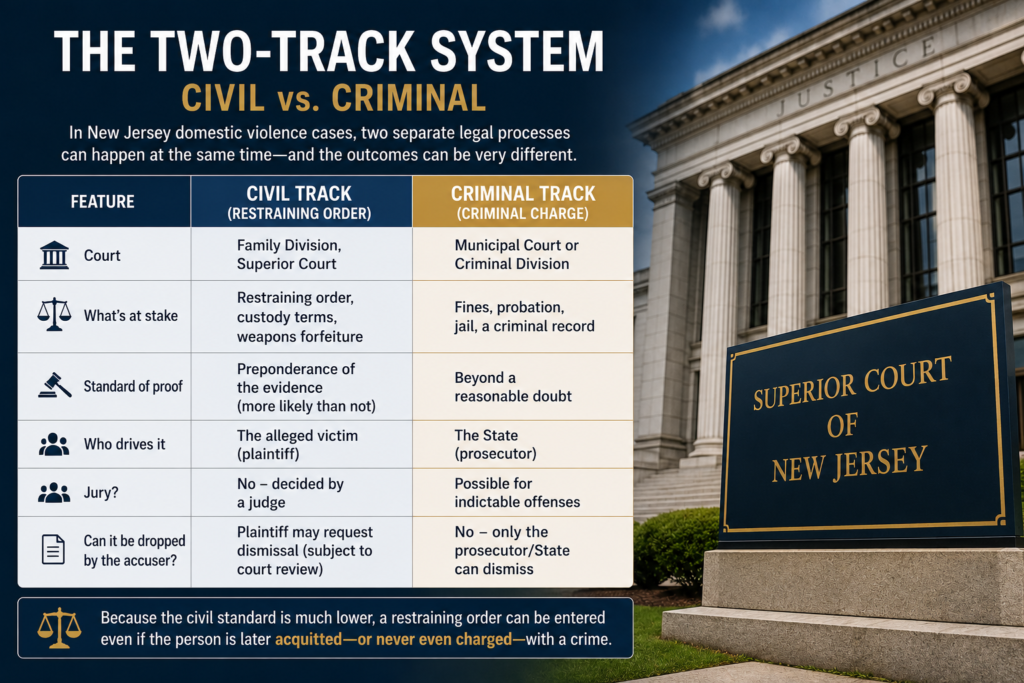
The Two-Track System
This dual structure is the single most misunderstood feature of New Jersey domestic violence law. Because the two tracks look similar to a layperson — same accuser, same incident, sometimes the same courthouse — people assume that beating one automatically beats the other. It does not.
| Feature | Civil Track (Restraining Order) | Criminal Track (Charge) |
|---|---|---|
| Court | Family Division, Superior Court | Municipal Court or Criminal Division, Superior Court |
| What’s at stake | A restraining order, custody terms, weapons forfeiture | Fines, probation, jail, a criminal record |
| Standard of proof | Preponderance of the evidence (more likely than not) | Beyond a reasonable doubt |
| Who drives it | The alleged victim (plaintiff) | The State (prosecutor) |
| Jury? | No — decided by a judge | Possible for indictable offenses |
| Can it be dropped by the accuser? | Plaintiff may request dismissal (subject to court review) | No — only the prosecutor/State can dismiss |
Because the civil standard is so much lower, a restraining order can be entered against someone who is later acquitted of — or never even charged with — a crime. Anyone facing this situation benefits from understanding both tracks at once, which is exactly why coordinated criminal defense representation matters from day one.
The Prevention of Domestic Violence Act
New Jersey enacted the modern Prevention of Domestic Violence Act in 1991. The Legislature’s stated purpose was emphatic: to assure victims “the maximum protection from abuse the law can provide.” Courts have read that language as a mandate to interpret the Act broadly in favor of protection — a fact that shapes how aggressively temporary orders are granted.
How the Statute Is Built
The PDVA does three core things:
- It defines the protected class — the relationships that qualify a dispute as “domestic.”
- It lists the predicate offenses — the specific crimes that, when committed within a protected relationship, constitute domestic violence.
- It creates the restraining order machinery — temporary orders, final hearings, and the enforcement (contempt) mechanism.
A critical nuance: the Act does not create new crimes. Harassment is still harassment under N.J.S.A. 2C:33-4; assault is still assault under N.J.S.A. 2C:12-1. The PDVA layers a protective-order system on top of the existing criminal code and channels these offenses through Family Court when the parties are in a qualifying relationship.
Who the Law Protects
Not every conflict between two people is domestic violence, even if it turns physical. The PDVA applies only when the parties share one of a defined set of relationships.
Protected relationships under the PDVA generally include a person who is:
– A current or former spouse;
– A present or former household member;
– Someone with whom the accused has a child in common (or is expecting one);
– Someone with whom the accused has had a dating relationship.
The “dating relationship” and “household member” categories generate the most litigation. Courts examine factors such as whether there was an expectation of affection, how long and how often the parties saw each other, and whether they held themselves out as a couple. Two roommates who never dated, or two strangers in a bar fight, generally fall outside the Act — that conduct is handled purely as a standard criminal matter, not as domestic violence.
Practical example: Priya and Marcus dated for four months in Hackensack, then broke up. Two weeks later, an argument by text escalates and Marcus sends a barrage of angry, threatening messages. Even though they no longer live together and never married, the prior dating relationship brings the conduct squarely within the PDVA — and the messages themselves may satisfy the harassment predicate.
What Counts as Domestic Violence
Conduct becomes domestic violence only if it fits one of the predicate offenses the Legislature enumerated. The list has expanded over the years and now covers a wide range of behavior — far beyond physical striking.
Commonly charged predicate offenses include:
| Predicate Offense | Typical Statute | What It Often Looks Like |
|---|---|---|
| Simple assault | N.J.S.A. 2C:12-1(a) | Pushing, slapping, causing minor injury |
| Aggravated assault | N.J.S.A. 2C:12-1(b) | Serious injury, use of a weapon |
| Terroristic threats | N.J.S.A. 2C:12-3 | Threat to kill or seriously harm |
| Harassment | N.J.S.A. 2C:33-4 | Repeated calls/texts, alarming communications |
| Stalking | N.J.S.A. 2C:12-10 | A course of conduct causing fear |
| Criminal mischief | N.J.S.A. 2C:17-3 | Damaging the other person’s property |
| Criminal trespass | N.J.S.A. 2C:18-3 | Entering a home the person was barred from |
| Cyber-harassment | N.J.S.A. 2C:33-4.1 | Threatening or lewd online messages |
Because so much modern conduct occurs by phone and text, harassment and cyber-harassment are among the most frequently alleged predicates in Bergen County filings. The line between an ugly breakup argument and criminal harassment is often thin, which is why these cases are so defensible — and so easy to over-charge. Related offenses like harassment allegations and stalking charges frequently appear alongside a restraining order request.
Restraining Orders: TRO to FRO
The restraining order process is where a domestic violence case moves fastest and where the accused has the least time to react.
The Temporary Restraining Order (TRO)
A plaintiff can request a Temporary Restraining Order at the Family Division during court hours or, after hours, from an on-call municipal court judge — sometimes by phone. The hearing is ex parte, meaning the accused is not present and does not get to tell their side. If the judge finds a TRO is necessary to protect the alleged victim, it issues immediately.
A TRO can, on its face:
– Bar all contact with the plaintiff (and sometimes children, family, and workplaces);
– Remove the defendant from a shared residence — even a home the defendant owns or leases;
– Grant temporary custody and parenting-time terms;
– Order the surrender of all firearms and weapons.
 The Final Restraining Order (FRO) Hearing
Within roughly ten days, the court holds a Final Restraining Order hearing. This is the real fight. Both sides may testify, present witnesses, and introduce evidence such as texts, photos, and medical records.
To enter an FRO, the judge applies the two-part test from Silver v. Silver:
- Did the defendant commit a predicate act of domestic violence (by a preponderance of the evidence)? and
- Is a restraining order necessary to protect the victim from immediate danger or further abuse?
Both prongs must be met. A single heated argument, without a genuine need for ongoing protection, may fail the second prong even if the first is arguably satisfied.
New Jersey is unusual: a Final Restraining Order has no expiration date. Unlike many states where orders last a year or two, an FRO in New Jersey is permanent unless a court later dissolves it. That permanence — and its effect on housing, employment, and gun rights — is why the FRO hearing should never be treated as a formality.
Restraining Order Timeline
| Stage | Typical Timing | What Happens |
|---|---|---|
| Incident / complaint | Day 0 | Plaintiff applies for a TRO |
| TRO issued | Same day (ex parte) | Immediate restraints take effect |
| Weapons surrender | Immediately | Firearms/FID card seized |
| FRO hearing | ~10 days later | Full hearing; judge decides on permanent order |
| Post-FRO | Ongoing | Order is permanent unless later dissolved |
Ten days is not much time to gather text logs, locate witnesses, and prepare cross-examination. It is the single strongest argument for contacting counsel the moment a TRO is served.
The Criminal Track and Its Penalties
Running alongside the restraining order is the criminal case for the underlying offense. Penalties depend entirely on which offense is charged and how it is graded.
| Offense | Grading | Typical Maximum Exposure |
|---|---|---|
| Harassment | Petty disorderly persons | Up to 30 days jail; fine |
| Simple assault | Disorderly persons | Up to 6 months jail; fine |
| Terroristic threats | Third-degree crime | 3–5 years prison; fine |
| Aggravated assault | Second–fourth degree | Up to 10 years, depending on degree |
| Stalking | Fourth-degree (or higher) | 18 months prison; fine |
Disorderly persons and petty disorderly persons offenses are generally heard in municipal court. Indictable crimes (third degree and above) move to the Criminal Division of the Superior Court — for this region, the Bergen County Justice Center in Hackensack. The gap between a disorderly persons offense and an indictable crime is enormous, and how the underlying conduct is charged — for instance, whether a physical altercation is treated as simple assault or elevated to aggravated assault — often determines the entire trajectory of the case.
Contempt: Violating the Order
Once a restraining order is in place, violating it is its own crime. Under N.J.S.A. 2C:29-9, contempt of a domestic violence order is generally a fourth-degree crime, and a second violation carries a mandatory minimum jail term. This is a trap for the well-meaning: replying to a “can we talk?” text from the protected party is still a violation, because the order — not the plaintiff — controls contact.
Weapons, Firearms, and Immediate Fallout
New Jersey treats weapons in domestic violence cases with particular severity. Under N.J.S.A. 2C:25-21, police responding to a domestic violence call may make a warrantless arrest where there are signs of injury, and may seize any weapons they reasonably believe were involved or pose a risk.
A restraining order typically triggers:
– Surrender of all firearms and ammunition;
– Revocation of the Firearms Purchaser Identification card and any permits;
– A federal prohibition on possessing firearms while the order stands.
For gun owners, hunters, security professionals, and law-enforcement officers, this consequence can be career-altering. Because it flows automatically from the order, related weapons charges frequently compound a domestic violence matter, and the firearms issue should be addressed as part of the defense strategy from the outset — not after the fact.
How a Bergen County Case Typically Unfolds
While every matter differs, a domestic violence case in Bergen County often moves along a recognizable arc:
- Police response and TRO. Officers respond to a call in Hackensack, Teaneck, Fort Lee, or elsewhere in the county. A TRO is obtained and, where warranted, the defendant is arrested and weapons seized.
- First appearance / bail. For a criminal charge, the defendant is processed and conditions of release are set.
- FRO hearing. Within about ten days, the Family Division hears the restraining order at the Bergen County Justice Center.
- Criminal case proceeds separately. Municipal court (for lesser offenses) or the Criminal Division (for indictable crimes) handles the charge on its own timeline.
- Resolution. Each track resolves independently — the FRO may be granted, denied, or dismissed; the criminal charge may be dismissed, downgraded, diverted, tried, or pleaded.
Practical scenario: After a loud argument, a Hackensack resident is served with a TRO and charged with simple assault. At the FRO hearing, cross-examination reveals inconsistencies in the timeline and no corroborating injury; the judge finds the second Silver prong unmet and declines to issue a final order. The criminal charge, held to the higher “beyond a reasonable doubt” standard, is later downgraded and resolved without a conviction. Two tracks, two outcomes — coordinated on one strategy.
Defense Options: What Actually Works
Effective defense is not about a single magic argument; it is about matching the right challenge to the right weakness in the case.
Factual and evidentiary defenses
- Credibility and inconsistency. Text logs, call records, and timelines frequently contradict the narrative in the complaint.
- Lack of a predicate act. If the conduct does not actually satisfy the elements of a listed offense, the first Silver prong fails.
- No need for protection. Even where something happened, the defense can show there is no ongoing danger — defeating the second prong.
Legal defenses
- Self-defense. New Jersey recognizes the right to protect oneself with proportional force; the person who called first is not automatically the victim.
- Relationship not covered. If the parties fall outside the protected categories, the PDVA does not apply at all.
- Constitutional and procedural challenges on the criminal side, including how statements and evidence were obtained.
The false-allegation reality
Domestic violence allegations sometimes arise from custody disputes, divorces, or attempts to gain leverage over a shared home. New Jersey judges are experienced at weighing motive and corroboration, and a disciplined defense can expose an allegation that does not hold together. Because the stakes are so high, the strongest results usually come from securing experienced domestic violence defense before the FRO hearing, while evidence can still be preserved and witnesses located.
Myth vs. Fact
| Myth | Fact |
|---|---|
| “If the accuser drops the charges, everything goes away.” | The State controls the criminal charge, not the accuser. And the restraining order requires a judge’s approval to dismiss. |
| “It was just an argument, so it can’t be domestic violence.” | Words alone — threats, repeated alarming texts — can satisfy harassment or terroristic-threats predicates. |
| “A restraining order is temporary and expires.” | A Final Restraining Order in New Jersey is permanent unless a court later dissolves it. |
| “I own the house, so they can’t make me leave.” | A TRO can remove even the owner or lease-holder from a shared residence. |
| “I can explain things directly to the other person and clear it up.” | Contacting the protected party violates the order and is a separate crime, even if they reached out first. |
Frequently Asked Questions
Is domestic violence a crime in New Jersey?
“Domestic violence” is a legal category, not a single crime. The actual charge is the underlying offense — such as assault, harassment, or terroristic threats — committed within a protected relationship. That triggers both a criminal case and a civil restraining order process.
What is the difference between a TRO and an FRO?
A Temporary Restraining Order is granted quickly, often without the accused present, to provide immediate protection. A Final Restraining Order is entered only after a full hearing where both sides present evidence. An FRO in New Jersey does not expire.
How long do I have before the final hearing?
Typically about ten days after the TRO. That short window is why gathering evidence and consulting a lawyer immediately is so important.
Can a restraining order affect my gun rights?
Yes. A restraining order generally requires surrender of all firearms, revocation of your Firearms Purchaser Identification card, and a prohibition on possessing weapons while the order is in effect.
What happens if I accidentally contact the protected person?
Any contact can be charged as criminal contempt under N.J.S.A. 2C:29-9. A second violation carries a mandatory jail term. Do not respond, even to a friendly or apologetic message.
Where are Bergen County domestic violence cases heard?
Restraining order matters are handled by the Family Division of the Superior Court at the Bergen County Justice Center in Hackensack; indictable criminal charges go to the Criminal Division there, while lesser offenses may be heard in municipal court.
Key Takeaways
- New Jersey domestic violence cases run on two tracks at once — a civil restraining order and a separate criminal charge — with different rules and outcomes.
- The PDVA (N.J.S.A. 2C:25-17 et seq.) defines protected relationships and the predicate offenses that qualify.
- A TRO is granted fast and ex parte; the FRO hearing happens in about ten days and can produce a permanent order.
- Restraining orders trigger immediate firearms surrender and can remove even a homeowner from the residence.
- Contact with the protected party is a separate crime, even when initiated by them.
- Strong defenses exist — credibility challenges, the two-prong Silver test, self-defense, and exposing false allegations — but the ten-day clock makes early action essential.
Glossary of Legal Terms
- PDVA: Prevention of Domestic Violence Act, New Jersey’s governing domestic violence statute.
- Predicate offense: One of the specific crimes that, within a protected relationship, constitutes domestic violence.
- TRO (Temporary Restraining Order): A short-term protective order granted quickly, often without the accused present.
- FRO (Final Restraining Order): A permanent protective order entered after a full hearing.
- Ex parte: A proceeding decided with only one party present.
- Preponderance of the evidence: The civil standard — more likely than not.
- Beyond a reasonable doubt: The higher criminal standard of proof.
- Contempt: The crime of violating a court order, including a restraining order.
- Silver test: The two-prong analysis courts use to decide whether to issue an FRO.
- FID card: Firearms Purchaser Identification card.
Conclusion
A domestic violence allegation in New Jersey can reshape a person’s life within hours — their home, their access to their children, their right to own a firearm, and their freedom, all at stake before the facts are ever tested. What makes these cases survivable is understanding that they are not a single, unstoppable event but a structured process with real rules, real burdens of proof, and real defenses. The two tracks can be fought. The Silver prongs can be contested. False or exaggerated claims can be exposed. But the window is narrow, and it opens the moment the papers are served.
If you or someone close to you is facing a restraining order or domestic violence charge in Hackensack or elsewhere in Bergen County, the most valuable thing you can do today is get clear, experienced guidance before the ten-day clock runs out.
If you’re facing a restraining order or criminal domestic violence charges in Bergen County, learn how an experienced Domestic Violence Lawyer in Hackensack & Bergen County approaches these cases and what to expect during every stage of the process.