New Jersey Domestic Violence Laws & Defense Options: A Complete Guide
Executive Summary
A domestic violence matter in New Jersey is rarely one case — it is usually two cases running at the same time: a civil restraining order proceeding in the Family Division of the Superior Court, and a separate criminal charge for the underlying offense. They have different courtrooms, different standards of proof, and very different consequences, and a person can lose one while winning the other.
This guide explains the framework created by New Jersey’s Prevention of Domestic Violence Act (PDVA), who the law protects, what conduct qualifies, how a temporary restraining order becomes a permanent one, what penalties attach to the criminal side, and the realistic defense options available to someone accused in Hackensack, Bergen County, and the surrounding region. It is written for the person who was served with papers yesterday and needs to understand, quickly and accurately, what is actually happening to them.
Table of Contents
- Domestic Violence in New Jersey: The Two-Track System
- The Prevention of Domestic Violence Act, Explained
- Who Is Protected? The Relationship Requirement
- What Counts as Domestic Violence: The Predicate Offenses
- Restraining Orders: From TRO to FRO
- The Criminal Track: Charges and Penalties
- Weapons, Firearms, and Immediate Consequences
- How a Bergen County Case Typically Unfolds
- Defense Options: What Actually Works
- Myth vs. Fact
- Frequently Asked Questions
- Key Takeaways
- Glossary of Legal Terms
- Conclusion
Understanding New Jersey Domestic Violence Law
Few areas of New Jersey law move as fast, or reach as far into a person’s daily life, as domestic violence. Within hours of an allegation, someone can be removed from their own home, barred from contacting their children, ordered to surrender every firearm they own, and left facing a criminal record — all before a single fact has been proven at trial. Understanding how the system is built is the first step to responding to it intelligently.
Direct answer: In New Jersey, “domestic violence” is not itself a single crime. It is a legal category defined by the Prevention of Domestic Violence Act (N.J.S.A. 2C:25-17 and following). When a person in a protected relationship commits one of a specific list of criminal offenses against another, the conduct is treated as domestic violence, which unlocks two parallel legal tracks: a civil restraining order in Family Court and a criminal prosecution for the underlying offense.
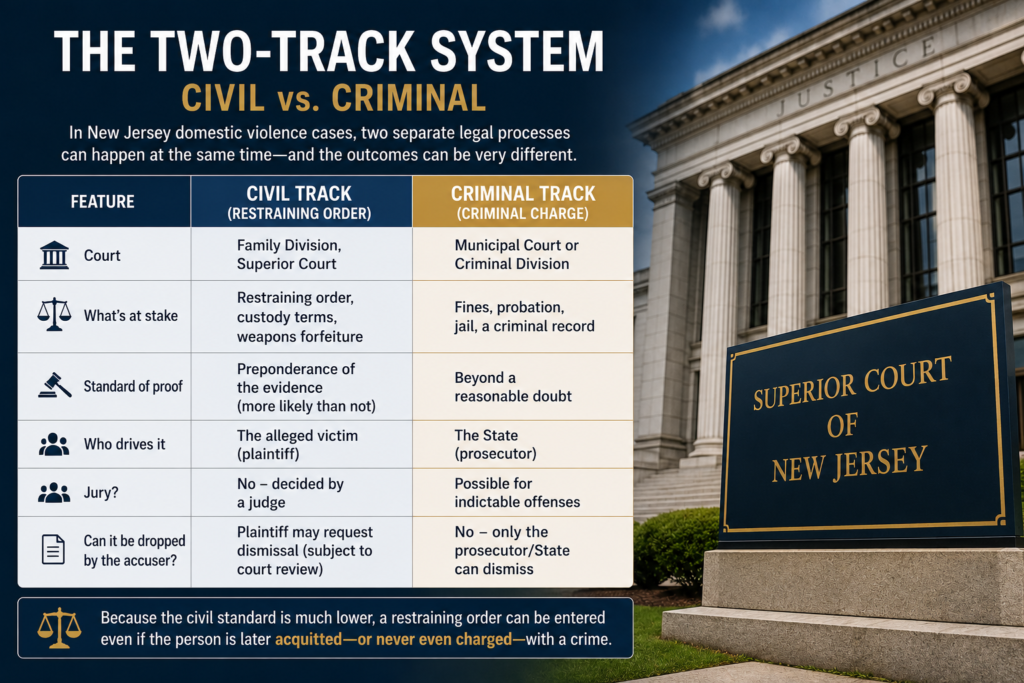
The Two-Track System
This dual structure is the single most misunderstood feature of New Jersey domestic violence law. Because the two tracks look similar to a layperson — same accuser, same incident, sometimes the same courthouse — people assume that beating one automatically beats the other. It does not.
| Feature | Civil Track (Restraining Order) | Criminal Track (Charge) |
|---|---|---|
| Court | Family Division, Superior Court | Municipal Court or Criminal Division, Superior Court |
| What’s at stake | A restraining order, custody terms, weapons forfeiture | Fines, probation, jail, a criminal record |
| Standard of proof | Preponderance of the evidence (more likely than not) | Beyond a reasonable doubt |
| Who drives it | The alleged victim (plaintiff) | The State (prosecutor) |
| Jury? | No — decided by a judge | Possible for indictable offenses |
| Can it be dropped by the accuser? | Plaintiff may request dismissal (subject to court review) | No — only the prosecutor/State can dismiss |
Because the civil standard is so much lower, a restraining order can be entered against someone who is later acquitted of — or never even charged with — a crime.…

 Entertainment
 Moving from the bustling streets of New York City to the sun-soaked landscapes of Los Angeles is not just a change in location; it’s a shift in lifestyle. The transition from the East Coast to the West Coast comes with a unique set of adjustments that go beyond geography. This article explores how individuals can navigate and embrace the lifestyle changes that come with moving from the energetic pace of NYC to the laid-back charm of LA.
 Whenever you are caught with drugs or suspected to be involved in such a crime, you may have to face several questions by the police. New Jersey is very serious about its drug laws any violation is strictly dealt with. Whether you have committed the offense or you have been framed, it is essential to know your constitutional rights and seek help from experienced
  Although a federal agency, the FBI is not a national police force, and law enforcement in the U.S. remains predominantly a responsibility of state and local governments. The FBIs core mission is to protect and defend the United States from terrorist, criminal, and foreign intelligence threats, uphold and enforce U.S. criminal laws, and provide criminal justice leadership and services to federal, state, municipal, and international agencies and partners. The FBI is also charged with ensuring compliance with the